
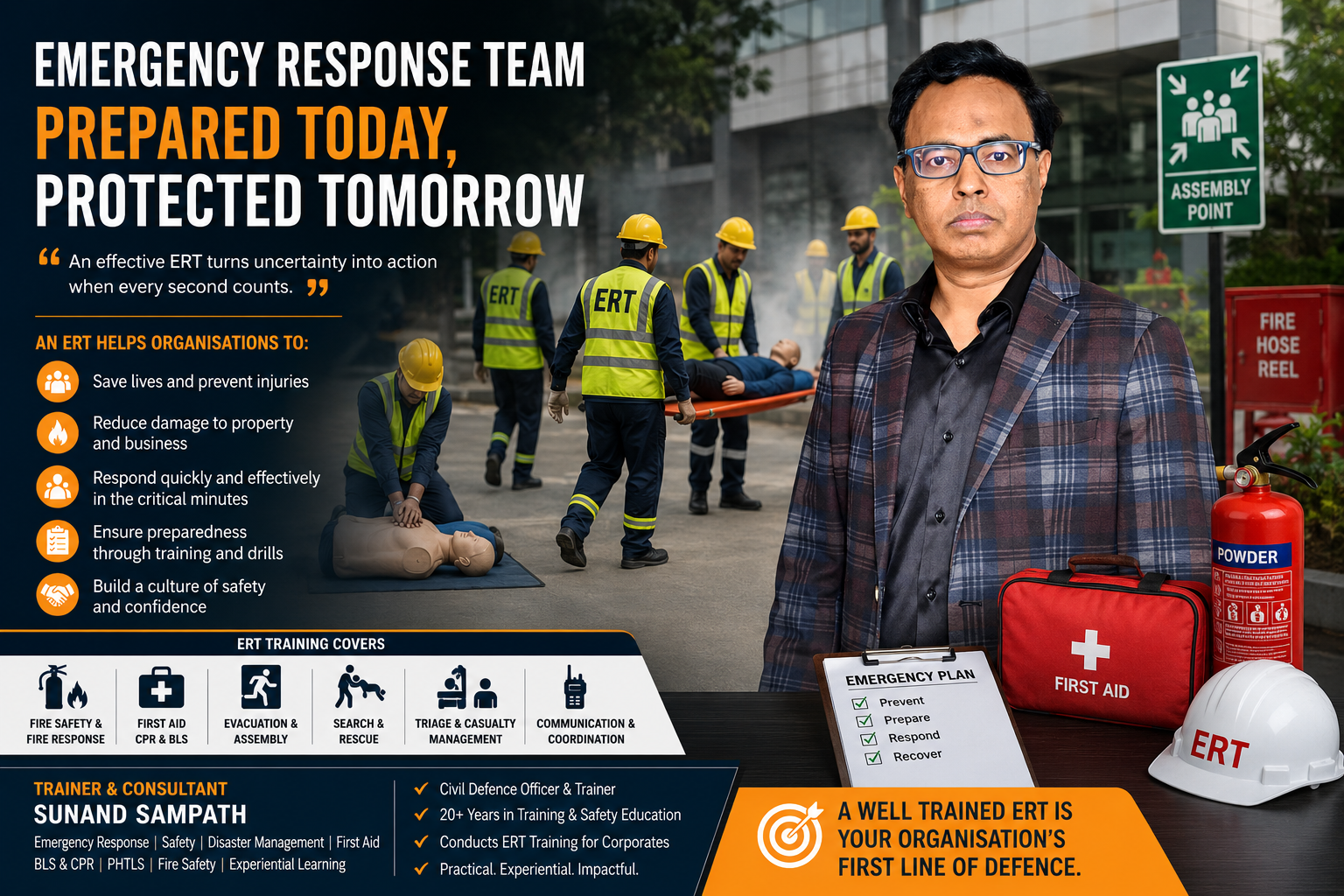
When Seconds Matter: Why Every Organisation Needs an Effective Emergency Response Team
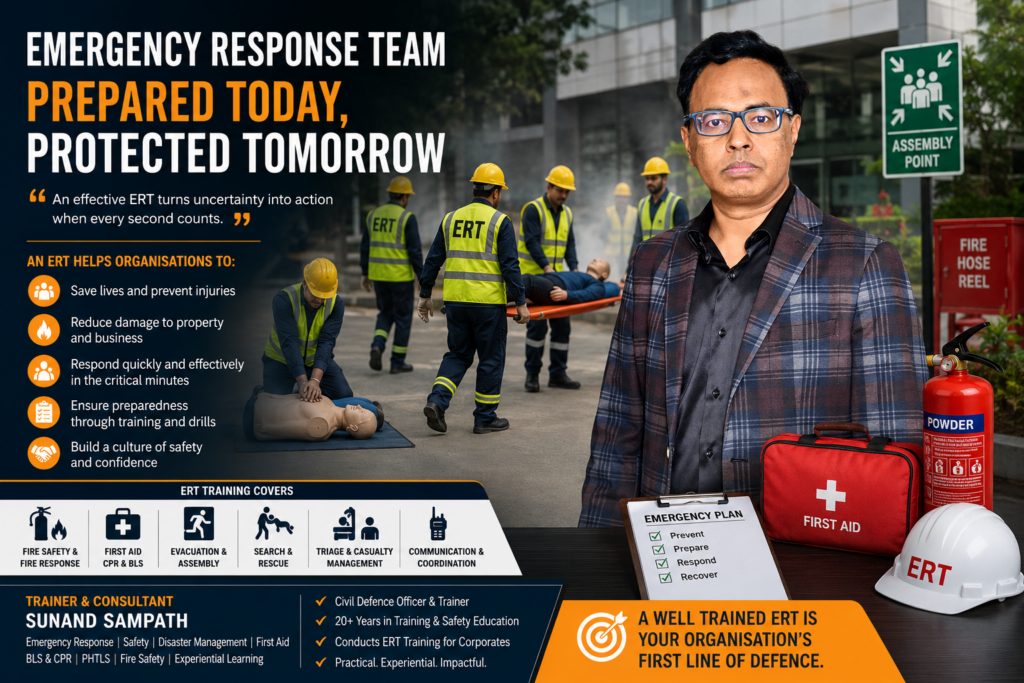
An emergency is not the time to decide who should do what.
A fire. A medical emergency. A chemical spill. A structural incident. A serious injury. A natural disaster.
When an emergency occurs inside a workplace, the first few minutes can make the difference between a manageable incident and a major disaster.
This is where an Emergency Response Team (ERT) becomes critical.
Over the Years I have trained ERT members in various Organizations, I personally Felt a great sense of fulfillment when I saw the difference these few Hours of trainings did to Employees, Teams and The organization as a whole,
Talking about a Positive Safety Culture, This definitely is eanbedded part of the same. An active ERT definitely changes the thought process even in the minds of those who are not a part of the team.
More Than Just a Team on Paper
Many organisations have an ERT because it is part of their safety system. Names are listed, responsibilities are assigned and perhaps a few drills are conducted every year.
But an ERT is truly effective only when its members are trained, confident and capable of taking the right action under pressure.
An ERT provides the organisation with trained people who can take immediate action until specialised emergency services arrive.
They become the organisation’s first responders.
What Does an ERT Actually Do?
The role of an ERT depends on the nature of the organisation and its risks, but typically involves areas such as:
- Emergency communication and incident reporting
- Fire prevention and initial fire response
- Evacuation and emergency assembly
- First aid, CPR and basic life support
- Handling medical emergencies
- Search and rescue principles
- Triage and management of multiple casualties
- Emergency preparedness and response procedures
- Coordination with fire, ambulance, police and other emergency services
- Participating in mock drills and continuously improving emergency plans
The objective is not to turn employees into professional firefighters, paramedics or rescue personnel.
The objective is to ensure that trained people are ready to act during the critical minutes before professional help takes over.
How Does an ERT Benefit a Company?
A well-trained ERT can significantly strengthen an organisation’s emergency preparedness.
It can help to:
Reduce loss of life and injuries by enabling immediate intervention.
Reduce damage to property and business operations through early action and effective evacuation.
Improve employee confidence by creating a workplace where people know what to do during an emergency.
Strengthen emergency preparedness by regularly testing plans through drills and exercises.
Improve coordination between employees, management, security, facility teams and external emergency services.
Most importantly, an ERT helps transform emergency response from panic and uncertainty into organised action.
Training Is the Difference
Simply nominating employees as ERT members is not enough.
They need to understand their roles, practise them and experience realistic scenarios.
This is why practical training and mock drills are such an important part of ERT development.
Training should not only teach what to do, but also allow participants to experience how it feels when something goes wrong.
That is where experiential learning becomes extremely valuable.
My Experience with ERT Training
Over the years, I have had the opportunity to conduct Emergency Response Team training programmes for corporate organisations, including organisations that are establishing their ERTs as well as companies with existing emergency response teams looking to strengthen their capabilities.
My training approach brings together my experience in fire safety, first aid, BLS, CPR, PHTLS, triage, disaster response, emergency preparedness and experiential learning.
As an emergency-response trainer, With a lot of experience with numerous Organizations I have also been involved in awareness programmes, emergency preparedness exercises and large-scale mock drills.
My objective during ERT training is simple:
I don’t want participants merely to know what to do. I want them to be prepared to actually do it.
Preparedness Begins Before the Emergency
The real value of an ERT is not seen when everything is normal.
Its value is seen when the alarm goes off, someone is injured, smoke fills a corridor, an evacuation is required or several people suddenly need assistance.
At that moment, there is no time to open a manual and start learning.
The preparation must have happened before the emergency.
Every organisation should therefore ask itself:
If an emergency happened in our workplace today, would our people know exactly what to do in the first five minutes?
If the answer is uncertain, it may be time to look beyond having an ERT on paper and start building an ERT that is truly ready to respond.
Because in an emergency, preparedness is not an option. It is the difference between reacting and responding.