
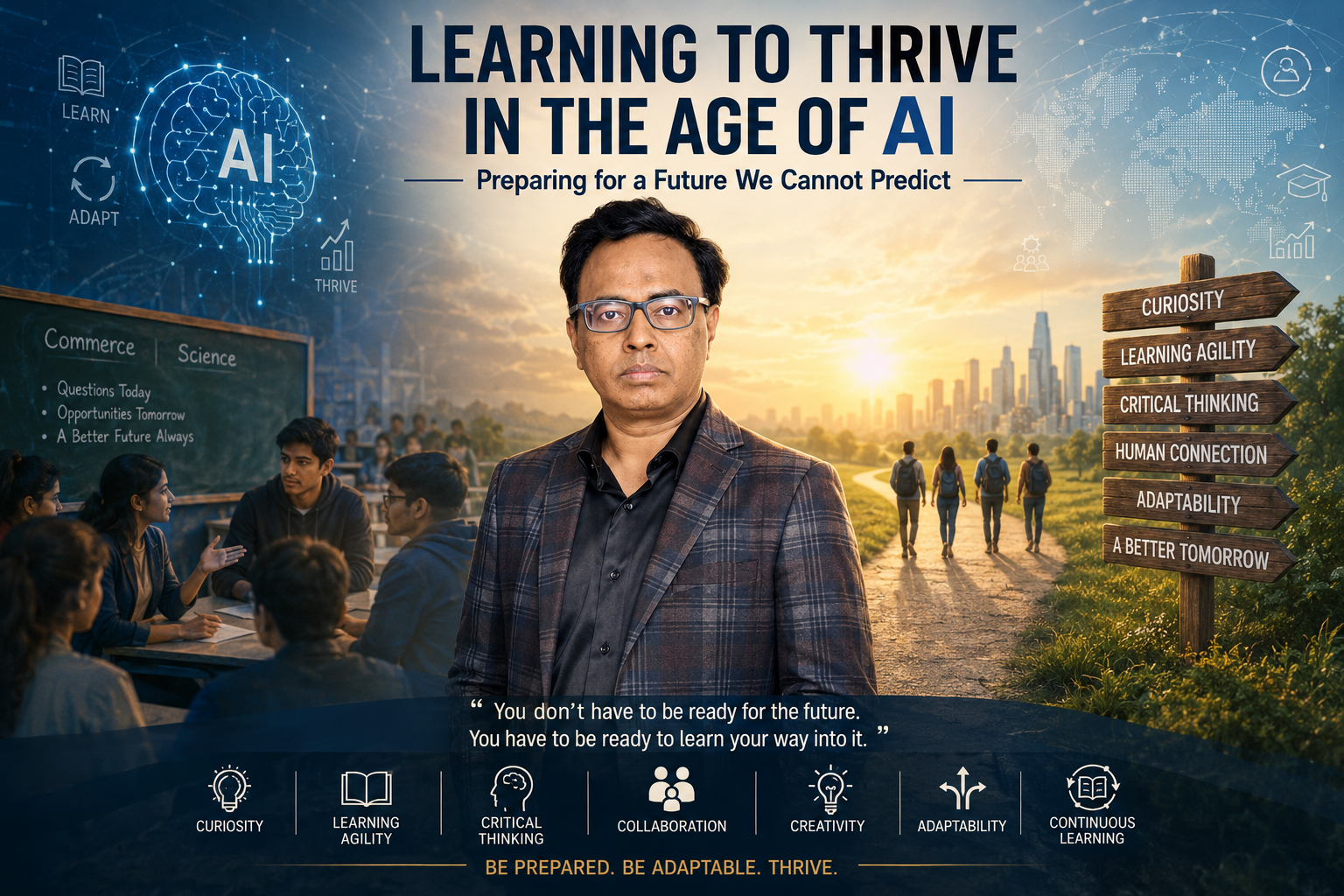
Learning to Thrive in the Age of AI Preparing for a Future We Cannot Predict
Recently, I had the opportunity to coordinate a series of sessions for students at the Pre-University level, bringing together students from both Commerce and Science streams. These were not students who lacked ambition or academic ability. On the contrary, they were high-performing students from a well-known institution, already thinking seriously about their future.
For the sessions, I invited a few friends with significant industry experience to interact with the students and share their perspectives on the world of work.
What stayed with me after these interactions was not any one particular question.
It was a larger feeling that seemed to exist on both sides.
What does the future actually hold for these young people?
The students were curious about careers, opportunities, skills and the changing nature of work. The management, too, was concerned about whether today’s education was adequately preparing students for tomorrow’s workplace.
And underneath many of these questions was one common factor:
uncertainty.
We are preparing young people for a future that none of us can clearly describe.
And then there is Artificial Intelligence.
The question that is difficult to answer
For a student studying Science or Commerce today, the traditional career pathway can no longer be taken for granted.
A student may ask:
Which degree should I pursue?
Which skills should I learn?
Which jobs will be available when I graduate?
Will AI replace some of the jobs I am preparing for?
Should I specialise or remain a generalist?
What will employers expect from me five years from now?
These are perfectly reasonable questions.
The difficulty is that we, as educators, trainers, parents and industry professionals, do not always have definitive answers.
The world of work is changing too quickly.
The AI factor
Artificial Intelligence has accelerated this uncertainty.
AI is no longer simply a technology discussed by scientists and technology companies. It is rapidly becoming part of everyday professional life.
It can write, analyse, summarise, translate, create, code, design and assist with decision-making.
For a young person entering higher education today, this creates an unusual situation.
They may spend three or four years acquiring a qualification, only to enter a workplace where some of the tasks associated with that qualification have already changed.
This does not mean that education has become irrelevant.
It means that the purpose of education needs to evolve.
Perhaps the question is no longer simply:
“What do we need to teach them?”
It is also:
“How do we prepare them to keep learning when what they have been taught changes?”
From certainty to adaptability
For generations, education offered a relatively predictable proposition.
Study hard.
Get a good qualification.
Find a good job.
Build a career.
But that proposition is becoming increasingly difficult to sustain.
The careers our students will eventually build may not follow a straight line.
They may change industries.
They may acquire entirely new skills.
They may work with technologies that don’t yet exist.
They may find themselves doing jobs that have no equivalent today.
This is why I believe we need to shift our thinking from career preparation to career adaptability.
We cannot prepare students for every possible future.
But we can prepare them to respond intelligently when the future changes.
The uncertainty gap
We often talk about a skills gap between education and industry.
But after interacting with these students, I wonder whether there is another gap we should pay more attention to:
the uncertainty gap.
Young people are being asked to make important decisions about their future at precisely the time when the future is becoming harder to predict.
And uncertainty can be uncomfortable.
It can lead to anxiety, comparison and an excessive focus on choosing the “right” career.
But perhaps we need to give young people a different message:
You don’t have to know exactly where the world is going. You need to become capable of navigating it.
What should a young professional develop?
If we cannot predict the exact jobs that will exist ten or fifteen years from now, perhaps we should concentrate on capabilities that will remain valuable across different futures.
Curiosity.
The willingness to explore, ask questions and remain interested in what is changing.
Learning agility.
The ability to learn, unlearn and relearn.
Critical thinking.
The ability to question information rather than simply accept the first answer—especially when that answer comes from AI.
Communication and collaboration.
Because even in an increasingly automated world, meaningful work will continue to involve people.
Creativity.
Not simply producing something new, but seeing possibilities and connections that others may not see.
Judgement.
Knowing what to do with information is often more important than simply having access to it.
And perhaps most importantly:
comfort with ambiguity.
Learning to make decisions without all the answers
This is where my own experience with experiential learning has made me think differently about education.
In many traditional learning environments, students are rewarded for finding the correct answer.
But real life rarely works that way.
A business decision may have incomplete information.
A scientific problem may have multiple possible approaches.
A team may disagree.
A disaster may evolve faster than the response plan.
An entrepreneur may have no previous example to follow.
In such situations, there may be no perfect answer.
There may only be the best decision possible with the information available at that moment.
Young people therefore need opportunities to experience situations where the answer is not obvious.
They need to experiment.
They need to make decisions.
They need to experience consequences.
They need to fail safely.
And then they need to reflect.
That is the real power of experiential learning.
The importance of experience
This is also why I found the interaction between industry professionals and students so valuable.
A textbook can explain a profession.
An experienced professional can tell a student what that profession actually feels like.
A curriculum can describe a workplace.
Someone who has spent years navigating that workplace can explain how decisions are really made.
These conversations help students connect education with reality.
And perhaps even more importantly, they help them realise that careers are rarely as linear as they appear from the outside.
The professional sitting in front of them may have changed roles, learned new skills, experienced setbacks, changed direction and adapted multiple times.
That itself is a lesson.
AI should not become a substitute for thinking
There is another challenge we must address.
As AI becomes increasingly capable, students may be tempted to use it as a shortcut to learning.
Why struggle with a problem if AI can provide the answer?
Why draft something if AI can write it?
Why research when a tool can summarise everything?
These are legitimate conveniences.
But education is not merely about producing an answer.
The struggle to find the answer is often where learning happens.
If we remove every opportunity to struggle, make mistakes and think independently, we may produce students who are highly efficient at obtaining answers but less capable of generating their own judgement.
The objective should therefore not be to keep AI away from students.
Nor should we allow AI to think for them.
We need to teach them to think with AI.
From “What will I become?” to “What can I become?”
Perhaps the most useful conversation we can have with young people is not:
“What job will you get?”
but:
“What capabilities can you develop that will allow you to succeed in many different jobs?”
That shift can be liberating.
A Commerce student does not have to predict exactly what the finance industry will look like.
A Science student does not have to predict which technologies will dominate a decade from now.
Instead, they can focus on becoming curious, adaptable, thoughtful, collaborative and capable of continuous learning.
Their first degree becomes a foundation—not a final destination.
What should institutions do?
This also places a responsibility on educational institutions.
We need to create more opportunities for students to interact with people outside the classroom.
Industry professionals.
Entrepreneurs.
Scientists.
Trainers.
Researchers.
Social workers.
Emergency responders.
Artists.
People who have taken unconventional career paths.
Students need to see that the real world is complex and that there is rarely a single formula for success.
They also need opportunities to solve real problems, work in teams, handle uncertainty and reflect on their experiences.
Perhaps the classroom of the future should not only ask:
“What is the answer?”
It should also ask:
“What would you do if there were no clear answer?”
We don’t have to predict the future
The conversations I had while coordinating these sessions left me with a simple thought.
We are sometimes putting too much pressure on young people to choose the right future.
But none of us can see that future clearly.
AI has made this even more obvious.
The answer, therefore, may not be to become better at prediction.
It may be to become better at adaptation.
We cannot tell today’s students exactly what jobs they will be doing in 2035.
We cannot tell them which technologies will dominate.
We cannot tell them which skills will become obsolete and which new ones will emerge.
But we can help them develop the confidence to say:
“Whatever changes, I will learn.”
“Whatever challenges arise, I will try to understand them.”
“If my first plan doesn’t work, I can adapt.”
“I don’t need to have all the answers today.”
That may be one of the most valuable forms of education we can provide.
Preparing for a future we cannot predict
The AI revolution is undoubtedly going to change the world of work.
But perhaps the biggest mistake we can make is to focus only on predicting which jobs AI will replace or create.
The more important question is:
What kind of human beings do we want to develop for a world that keeps changing?
My recent interactions with these young students reinforced my belief that the answer lies not merely in adding more technology to education.
It lies in developing curiosity, adaptability, judgement, resilience, creativity and the ability to learn continuously.
Technology will change.
Jobs will change.
Industries will change.
But the ability to learn from experience, reflect, adapt and continue growing will remain valuable.
We cannot predict the future for today’s students.
But perhaps we don’t need to.
Our responsibility is to help them become capable of thriving in whatever future eventually arrives.
And perhaps the most important lesson we can give them is this:
You don’t have to be ready for the future. You have to be ready to learn your way into it.
, Lot of Thoughts and Lot of Hopes
Sunand Sampath