
Beyond Lectures: Inside a Disaster Management Drill
The atmosphere changed the moment the emergency message was passed.
A few minutes earlier, participants had been casually interacting, discussing instructions, and preparing for the session ahead. Suddenly, the environment shifted. Information had to move quickly. Teams had to organize themselves. Decisions had to be taken under pressure. Communication became critical. Confusion started appearing in small pockets — exactly the kind of confusion that emerges during real emergencies.
That transformation is why disaster management training cannot remain confined to classroom lectures alone.
My Intention of writing this article is to Sensitize the importance of Experiential learning among Institutions, and General Responsible people.
Recently, I had the opportunity to conduct a disaster management session followed by a realistic emergency response drill designed to simulate the pressures and unpredictability of a real incident. The objective was not merely to “teach” emergency procedures, but to help participants experience the dynamics of response, coordination, communication, and decision-making under stress. this was organized for the Karnataka Civil Defence Wardens at its Academy,
One of the biggest gaps in many training programs is that people understand concepts theoretically but struggle when required to apply them in rapidly changing situations. Emergencies rarely unfold in a neat or predictable manner. Information is incomplete, communication channels become overloaded, emotions rise, and priorities keep shifting. It is in these moments that preparation, structure, and teamwork become invaluable.
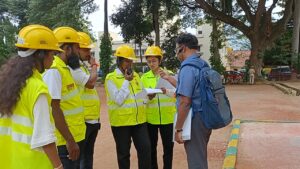
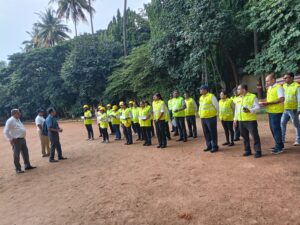
With this in mind, the drill was designed around several key elements.
Command and Control
One of the primary focus areas was establishing a functional command and control structure. During emergencies, even capable individuals can become ineffective if there is no clarity in leadership and coordination.
Participants had to quickly understand:
- who was responsible for what,
- how information should flow,
- how decisions would be communicated,
- and how teams could function without creating additional chaos.
Interestingly, the exercise demonstrated something that is often seen in real-life emergencies — leadership naturally begins to emerge when people are placed in challenging situations. Some participants who were initially quiet stepped forward confidently, while others discovered the importance of listening, coordinating, and supporting the larger response effort.
Emergency Communication
Another critical component of the simulation was communication management.
In emergency situations, communication failures can become more dangerous than the incident itself. Delayed information, unclear messaging, assumptions, and panic can significantly affect outcomes.
The drill therefore included controlled communication challenges designed to test how effectively participants could:
- relay information,
- maintain clarity,
- avoid misinformation,
- and coordinate between different response teams.
Participants quickly realized that communication during emergencies is not merely about speaking — it is about transmitting accurate information calmly, clearly, and at the right time.
Even simple instructions become difficult when pressure increases.
That realization alone became one of the most valuable learning experiences of the session.
Designing Realistic Simulation
A simulation becomes meaningful only when it feels realistic enough to trigger genuine reactions.
The drill was therefore structured to introduce:
- uncertainty,
- time pressure,
- rapidly evolving scenarios,
- role-based responsibilities,
- and practical response challenges.
The idea was not to create panic, but to create immersion.
Participants had to think beyond textbook answers. They had to assess situations, prioritize actions, coordinate with others, and adapt continuously as the scenario evolved.
What made the exercise especially impactful was watching participants transition from hesitation to structured response. In the beginning, there was visible uncertainty. But as systems started forming and communication improved, confidence levels also began to rise.
That transformation is the true value of simulation-based learning.
Training First Responders
Emergency response is not only about technical skills. It is equally about mindset.
A well-trained first responder must learn to:
- remain calm under pressure,
- think clearly despite confusion,
- communicate effectively,
- work within a team,
- and make decisions with limited information.
These abilities cannot be developed through lectures alone.
They must be practiced.
The drill also highlighted the importance of teamwork. No individual can manage an emergency situation alone. Effective response depends on coordination, trust, situational awareness, and disciplined execution.
Participants experienced firsthand how even small delays, unclear communication, or overlapping responsibilities could affect the efficiency of the response effort.
At the same time, they also experienced how quickly situations improve when teams communicate well and work with structure.
The Human Side of the Exercise
Beyond all the technical aspects, what stood out most was the human element.
Some participants who initially appeared unsure gradually became composed and confident. Others discovered strengths in coordination, leadership, and problem-solving that they may not have recognized earlier.
The drill became more than an exercise in emergency response. It became an exercise in awareness, adaptability, teamwork, and confidence-building.
One of the most important lessons participants took away was that preparedness is not built during disasters — it is built long before they happen.
Training creates familiarity. Familiarity reduces panic. Reduced panic improves decision-making.
That chain can save lives.
Final Reflections
A successful drill is not one where everything goes perfectly.
A successful drill is one where weaknesses are identified before a real emergency exposes them.
Every simulation reveals gaps:
- communication gaps,
- coordination gaps,
- leadership gaps,
- procedural gaps,
- and sometimes even confidence gaps.
But identifying those gaps in a training environment is precisely what makes preparedness stronger.
As trainers and facilitators, our responsibility is not merely to conduct sessions. It is to create learning experiences that prepare people to respond effectively when situations become difficult and uncertain.
Because in real emergencies, preparedness is not measured by what people know.
It is measured by how people respond.
Over the Years I have designed and implemented various Drills ranging from Fire Drills, Triage Drills, Disaster Simulation Drills etc for various Types of Groups ranging from First responders, Corporate employees, NGOs, school students etc, Only one thing is common that Participants learn through what they do, a mix of Theory and practice is important. An openmindedness and willingness to learn and the positive growth mindset is also important,
I hope to connect and share these skills with many more individuals and make spaces more safer.