
Why Experiential Learning Changes People Faster Than Classroom Lectures
I still remember a particular leadership camp many years ago.
A group of students had come for an outbound experiential learning programme. Like most young participants, they arrived with excitement, energy, and a little hesitation. Some were outspoken. Some preferred to stay in the background. A few believed leadership simply meant giving instructions loudly.

at First, during one of the outdoor problem-solving activities, the team completely failed.
Not because they lacked intelligence.
Not because they lacked knowledge.
They failed because nobody listened to each other.
One student kept shouting instructions. Another stopped participating after being ignored. A few simply waited for someone else to solve the problem. The exercise that should have taken fifteen minutes or lesser stretched endlessly.
Later that evening, during the reflection session around the campfire, something interesting happened.
The same students who had confidently spoken about “teamwork” in the classroom began talking honestly about frustration, ego, fear, communication, and trust. One participant quietly admitted,
> “Sir, today I realised I speak *to* people, not *with* people.” ‘Also saw a different side of communication when we ere engaged in these activities’
That realization did not come from a lecture slide.
It came from experience. Other students. too echoed similar thoughts
And that, perhaps, is the greatest strength of experiential learning.
Information Can Be Told. Understanding Must Be Felt.
Traditional classroom lectures are important. They provide concepts, frameworks, and foundational knowledge. But many life skills cannot truly develop through listening alone.
You can explain teamwork for hours.
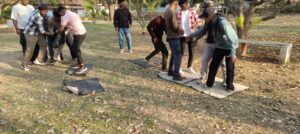
But when people must cross an obstacle together using limited resources, suddenly communication becomes real.
You can lecture about stress management.
But when participants are placed in a timed simulation with uncertainty and pressure, they discover how they actually react under stress.
You can teach leadership theories.
But leadership reveals itself much more honestly during a difficult trek, a rescue simulation, or a group challenge where conditions are unpredictable.
Experiential learning creates situations where people do not merely *hear* ideas — they *live* them.
And human beings remember experiences far longer than instructions.
Why People Change Faster Through Experience

One reason experiential learning is powerful is because it engages the whole person.
Not just the mind.
It involves emotions, decision-making, behaviour, relationships, uncertainty, and consequences. When people actively participate, learning becomes personal.
A lecture may be forgotten after a few days. even after a few hours sometimes.
But people rarely forget:
* the moment they overcame fear while rappelling,
* the challenge of coordinating a team activity,
* the discomfort of failure,
* or the satisfaction of solving a difficult problem together.
Experiences create emotional memory.
And emotional memory creates lasting learning.
Failure Becomes a Teacher
In many classrooms, people are afraid to fail.
In experiential learning, failure often becomes the starting point of growth.
Some of the most meaningful learning moments happen after an activity does not go as planned.
A team that performs poorly begins asking: Ada any. encourage the timbers to ask
* What went wrong?
* Why did communication break down?
* Did we assume instead of listening?
* Did we panic under pressure?
These reflections create self-awareness.
And self-awareness is where real behavioural change begins.
Learning Beyond the Classroom

Over the years, I have had the opportunity to work with:
* management students,
* Student various stages like UG, PG even school students
* corporate teams,
* teachers,
* emergency responders,
* youth groups,
* and disaster management volunteers.
Interestingly, regardless of age or profession, one pattern remains the same:
People learn faster when they are emotionally involved in the learning process.
A disaster management simulation teaches preparedness more effectively than merely reading a manual.
A first aid demonstration creates confidence faster than theoretical instruction alone.
A leadership activity reveals behavioural patterns more honestly than a written test.
Experiential learning transforms learning from something passive into something deeply human.
The Role of Reflection
However, experience alone is not enough.
The real magic happens during reflection. The is the Integral part of my interventions.
After every activity, discussion, simulation, or outdoor exercise, participants must pause and ask:
* What happened?
* Why did it happen?
* What did we learn?
* How does this apply to real life?
Without reflection, an activity remains entertainment.
With reflection, it becomes education.
This is what separates experiential learning from simply “having fun.” . I am Known for my reflection sessions,
Final Thoughts
In today’s world, information is everywhere.
People can watch videos, attend webinars, read articles, and access endless content online.
But transformation is different from information.
Transformation happens when people experience something deeply enough that it changes the way they think, feel, or behave.
That is why experiential learning continues to remain one of the most powerful forms of education.
Because sometimes, a single meaningful experience can teach what hours of lectures cannot.
I shall stop this post for now, I haven’t yet spoken about ‘out of box thinking’ , dealing with various types of fear, Mindfulness, and various related topics, and shall post about them in future posts.
Sunand Sampath